Tuesday, 28 June 2011

Massimo, Deirdre & Pombal. The buddies encounter Wulf


La Venus del espejo (Toilet of Venus) by the Spanish Golden-Age painter Diego Velázquez (1599–1660). Was she a real redhead? Click the link (Wikipedia) for attribution

Massimo [read the original in Italian] checked the GPS tracking software. “4 minutes and Deirdre would reach home” he thought.

Attribution
Pure or impure goddess?

How would the mystery of the beautiful Irish girl be solved?

Massimo was extremely tense. He needed the Hermetics (whose profound words usually brought him peace) but reading them would require time. And God knows where his Alhambra was. He loved to caress its strings, its rich textured sound so well suiting the temperament of a dreamer.

That damn Russian Ukrainian, Pombal, - in honour of whose genius he had given away a room of his apartment for a ridiculously low rent - must have taken it to the Piazzetta with him or put it back in the late 18th century wardrobe that uncle Carlo had left him before he died.

Fortunately long-time meditation on ancient texts allowed him to improvise and vibrate with words now dead.

Classical Guitar. Click for attribution


Deirdre, Deirdre,
num nec tecum
possum vivere
nec sine te?


[Deirdre, Deirdre,
perhaps can I live
neither with you
nor without you?]


Eyes of a thoughtful green blue, long and perfect legs, sensual hips ... and what about her pale skin? Oh that face, her thriving breasts, and whitest arms and hands that, he sensed, knew how to give happiness in silence clinging …

Deirdre, splendid and crimson-haired creature, who seemed as if carved first and then polished for years by an ancient sculptor gone mad ...
He felt a pang. Weren't the rosci cursed by the gods?? ['roscio is red-headed in Roman'; note by 'he who is writing']. 
Goddess & mother of all dreams - or filthy whore with a deceitful heart? 
Since - Massimo thought not without anguish - some of her statements during their last date could not be uttered but by those who ... 
He drove his mind ghosts away with anger. The matter could be very serious and demanded lucid force. 

He doubled his speed of reading, which is normally between 250 and 350 words per minute in Italian. 

Italian ex soccer player Stefano Bettarini. Attribution
Giorgio many years earlier, in order to help his pupil with school work, had taught Massimo various speed-reading techniques. And Massimo, once a successful soccer player then badly injured and turned into a flop, was now accustomed to make use of ALL of them alternatively, ie according to texts, to the environment (or to his own whim). Only two of them increased reading speed enormously but greatly reduced text comprehension.

ψ

The sentences were now taking shape out of the screen fonts (just Pythagorean combinations he reflected). Concepts and images began to flow more rapidly into his mind.

Helmet found in Sutton Hoo, Suffolk, England (6th cent. CE)

Giorgio so continued:

“At some point a giant with noble eagle eyes appeared in the doorway of the taberna.

Long blondish hair coarsely ringed, beard and moustache, muscular body clad in wolf and deer skin, metal plates that protected his broad chest, the Germanus wore a long sword hanging from a wide belt made of badger's (or boar's) fur.
A true colossus, Massimo, and showing that pride which in those days was (and still is) a mark of command.

His appearance raised murmurs of approval, respect (and fear).

Some Angles began to clamour by hitting their weapons unto their shields and shouting "Wulf! Wulf! Wulf."

Others gathering to the left of the giant, a powerful figure at their centre, looked at him with rancour. The members of a rival clan?

Wulf checked the room and quickly identified the foreigners, they standing out against the mass of the locals as the most beautiful golden ears stand out against a field of wheat shaken by the evening wind.

The Roman men were playing dice and discussing Qwil’s bizarre disappearance a few hours earlier (“Absolutely typical of him” Philippus and Chaerie had commented but Jenny had rebuked their Germanic friend from Vindobona in absentia by saying: “What an IDIOTIC thing to get lost in such a dangerous environment!”).

They all also debated a painful encounter that had occurred in the nearby village prior to their decision to reach the taberna and forget their woes for a bit.

The women, laughing while betting on dice combinations, their voices so silvery, dear Massimo, as if Beauty, Soul's Nobility & Eros had incarnated in their joyful personae; the Syrian ladies hiding naughtily behind their embroidered veils and at the same time trying to evaluate the wealth of potential customers; and Pavlos, our resourceful Greek merchant, enwrapped in dreams before a mysterious a wax tablet: the figures of his commerce or winged words that made him fly elsewhere?

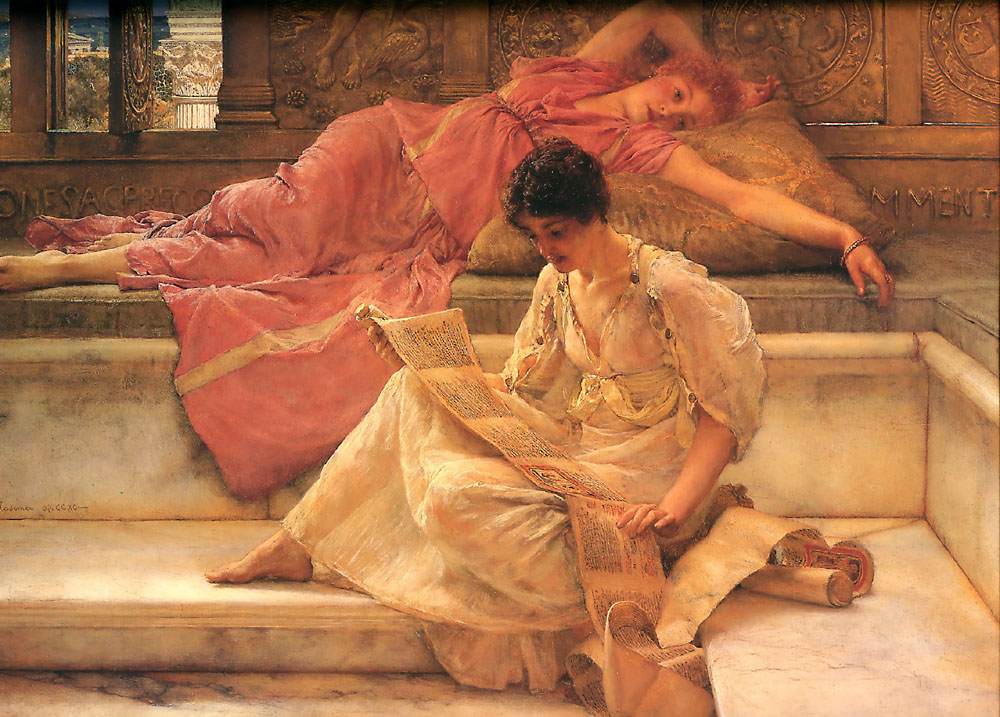
Two Roman women reading their favourite poet as they were imagined in 1888 by Lawrence Alma-Tadema (1836–1912). Detail. Click for attribution and to enlarge

You gotta know Massimo that – but don't feel like telling ya why ok? I know I'm getting neurotic ok? - a Romano-British slave, a certain Coalan, square-faced and rodent grey eyed, had noticed the presence of the weird group in the taberna (or longhus, as the Angles call it) and had rushed to inform Ogden and Kaelan, Wulf's sworn friends from the day when the three of them, as children, had drunk their respective blood.
Coalan was the property of the warriors’ clan and part of Wulf's personal network of informers. His father had implored the Germans for mercy in the course of a raid and had obtained life for him and his family (but not freedom).

A mid-20th century reconstruction of a Danish long house in Hobro, Denmark. Click for attribution

"They are mostly Romano-British in the old way - he had told them - who, in addition to the British language still speak Latin together with an absolutely incomprehensible tongue, and who dance and sing in so unusual a manner that our longhus risked turning into a place of, ehm, absolute revelry.

To these words a brief description of the group had followed, as a result of which the two friends had looked at each other with a gleam in their eyes (did it correspond to Manius' stories on his far-away friends?) and had quickly sent a fast horseman in the forest where Wulf was hunting.

This is why Massimo, dear friend and former pupil, such a colossus had rushed into the taberna.

[“Dear Master - Massimo, this dark-haired and dark-eyed real Roman from Rome, had thought ('what a black-haired clone of A.S. Roma's player Francesco Tutti you are' Pombal often kidded him), - I know I must be strong also for you now that you've become unsure, and, well, an old fart - let me call a spade a spade.”]

The Roma soccer team logo. Attribution

The friends immersed in their dice game & conversation realized only at the last moment that an immense blonde tower had appeared less than a yard from their noses and that, terrifying in its mass, was shouting with a thundering voice incomprehensible words:

"Ic freond, IC FREOOOOND, ond ...”

The reaction of the men in the group was fast - in those times even a second of distraction could mean death.

Six Romano-Britons, their gladii already in their hands, turned the massive table upside down against the giant (gladii are lethal when used by trained Romans). Pavlos pulled out an inlaid-with-gold throwing dagger he always carried with him (even in bed?). He had already shown his ability to use it with deadly precision. The women were looking at the giant with contempt and challenge. The courtesans were instead screeching like scared gulls, although one of them concealed a stone in her delicate, ringed hand.

Anglo-Saxon House, Bury St. Edmunds, United Kingdom
This travel blog photo's source is TravelPod page: Such Fun!

The sudden action of the Romans was followed by a reaction from the Angles who were in the immediate vicinity. Easy to anger, some began to hurl themselves against the group of strangers.  The men would pay with their lives (and the women with a humiliating slavery) for the unspeakable offence to their leader.

The buddies saw themselves surrounded by some dozens of furious men. Arrows, lances and swords were pointed towards them. Ready to sell their lives dearly they knew that their death was near since the fighters' ratio was of one to four.

ψ

At that moment a roar rent the air.

The heavy table flew away as if it were made of paper.

The gigantic man emerged from the floor.

Looming over the bunch of buddies he unsheathed his huge sword with flashing blue eyes ...


Monday, 30 May 2011

Witch 2b. The Cretan dance. Fauna appears

Venus Verticordia by Dante Gabriele Rossetti (1828-1882). Wikipedia. Attribution
Venus was also called Verticordia by the Romans since she was capable of 'changing human hearts'. Worshipped during the Veneralia festival (April 1) Verticordia had a temple on the Via Salaria


[Read the Italian original. An Englishman living in Milan, Andy, is helping me with some editing.]

Taken aback by the inexorable trajectory - I was always good with the javelin do you recall Quintus? - the lass however succeeded in propelling herself forward with such impetus that the deadly lance missed her abdomen and tore her tunic at the level of her hindquarters without scratching her flesh I believe.

The force that had driven her forward was so lethal I was thunderstruck.

I therefore took my bow.

Arrows whistled in quick succession though wavered on purpose (unpredictability is deadly, remember?). She nevertheless avoided my darts by performing this odd dance on the rump of her horse (of undoubted Cretan origin, Quintus).

Bull leaping. Minoan fresco from palace of Knossos, Crete, currently in the Herakleion museum

She circled with elegance, an inhuman melody emitting from her throat - a terrible buzz, deep and acute - her fair legs now concealed now flashing through the cracks of her tunic.

And I, closer and closer, our steeds' flanks dangerously scraping against each other, my arrows all gone, what happened Quintus was that I became so enchanted and progressively unwarlike due to that mysterious creature.

Although the worst was yet to come, Di Manes!

After the Cretan dance the girl had assumed a crouched-on-all-fours, feline position on the rump of her stallion, launched at breakneck speed on the forest damp obscure recesses. The siren of the woods had lowered her shoulders, arched her back and pointed her rear upwards whose perfect roundness was thus offered to my view.

A sculpture from the Norman Lindsay House (see last image below for infos). Attribution

The sun bursting through the clouds heralding a spectacular sunset, the noise of animals becoming deafening, I was there, those half & symmetrical moons in front of me, so close that I could almost touch them, a pale-skinned double globe with designs of a delicate blue.

Her garment lacerated by my pilum on her hindquarters did not keep much from sight Quintus! Geometries made sensuality, ideas of beauty made flesh were exposed and stirring deliria of sumptuous pleasures and everlasting feelings of lust & love.

Well, such unchaste commotion, dear friend of better days, ended up with being fatal to me.

The flaming haired maiden took advantage of my confusion and making use of the arm hidden from my sight grasped, from her bag, strings to whose ends small brass spheres were attached.

She then hurled the strange weapon with such vehemence in the direction of Hælend's legs that both horse and rider - that is, us – couldn't but fall to the ground with a loud crash due to the speed of the race.

The tattooed female's craftiness, however, cost her dearly as well since her stallion (was he confounded also?) stumbled in turn over superficial roots and hurtled down over the mossy weeds & soil with an even louder crash due the beast's bulk.

Another Lindsay's sculpture. Attribution

I hit my head on the turf and got scratched all over.

My initial stunned condition prevented me from realizing at first that the picta had vanished but her horse was lying down on the ground nearby and was letting out neighs of pain.

Hælend, up already instead, was calmly approaching the Italian thoroughbred which she coldly executed with three violent (and accurate) kicks in the head.

Hælend looked at me, a look of revenge in her eyes. The victory of valour over nobility? Well, how could I blame her. Moreover the white stallion was wounded and had to be dispatched. The wolves that haunt the forest would have caused him a horrible death.

Hælend then walked towards me. The expression of her eyes revealed kindness, concern. She licked my wounds and as if by miracle I immediately felt better. I got up and stretched. Hector, my gladius, was still on me and my helmet I found behind a bush.
Hælend, satisfied, was already in a nearby meadow grazing Albion's emerald grass.

Well, Quintus, we know too well she isn't as classy as an Italian horse (I can well believe it!) but what a fantastic gift from the Angles and the Genii protecting our Rome!
Therefore I couldn't but chant:

Non ergo essem
dei Romae mei
Orientisque Aegyptorumque,
non omnino essem,
nisi essetis in me...
[I wouldn't exist then
Ye gods of Rome,
Of Egypt & the Orient,
I wouldn't exist
If ye weren't in me ...]

Isis mothering. Credits

This song, performed with Egyptian tones (I'm a decent singer, I'll admit) was followed by a profound growling that left me disconcerted, since the forest animals had fallen silent, frozen.

I became afraid. Had my psalm been inappropriate? Had the British gods gotten angry at how I had dealt with that red-headed Albion's daughter?
The thing is, lost as I was in my doubts I hadn't noticed the Creature. Who with quiet footsteps was heading toward me.


She,
Feral Being, goat goddess
By shepherds & peasants loved
And horribly feared,
Emerged before me.


This is how we imagine Fauna. Sculpture from the Norman Lindsay gardens. Lindsay was an Australian artist, sculptor, writer, editorial cartoonist, scale modeler & boxer (1879-1969). Attribution


The Creature, daughter of Hermes and Dryope, let out a cry and the wood resounded.

Then she seized me, her body steaming with humours. One cannot escape from a goddess ...

My surrender to such a beastly pleasure let go from my memory the rumour that those dei inferi were supposed to have died with the advent of Christ ...

Not that it mattered. A sudden tune played on marsh reeds made ​​the air vibrate together with my senses.

Too late I realized my foolhardiness. The last beam of sunlight, violent and unexpected, pierced the scene and Pan's cry was heard again, terrifying.

Uncontrollable panic shook my whole person.

And Fauna, Bacchus' lascivious companion, - arms hands legs and bodies giving and receiving pleasure - gripped with extreme violence what makes me a man.

My scream, though not panic as hers, ripped through the night that was about to lazily fall upon the wood.

All then was nothing. Darkness closed in.

Thursday, 19 May 2011

Witch 2a. Striking to kill

[I recognized her immediately Quintus. It was that savage now badly disguised as a lady. Disguised as a lady? Ah she really needed a lesson from a civilized Roman!]


I advanced in her direction.

She had less blue paint on her face now although her beautifully moon-white skin was of course still adorned with blue tattoos all over.

Her tunic had long ornamental cuts showing glimpses of a muscled and perfectly shaped leg, which confounded me for an instant – you know this weakness I have for long and well-shaped legs (not to mention curves) on the body of a woman.

She appeared concentrated on three strange trees rich with berries of three different colours - white, red, black - one for each tree.

From the bag across her horse’s back I caught sight of more berries plus herbs, mushrooms, roots – all of amazing colours.
"F@%& her suave beauty!" I cursed and gotten off my horse I began to run towards her.

She was quicker. A phosphorescent glare amidst a halo of red hair and away they vanished - the woman and the stallion - into the deep of the wood.

I felt Hælend’s snout behind me so I swiftly turned around, jumped unto horseback and the chase began.

I soon got closer but at the last moment the picta dashed away with her stallion. Got closer again and to my surprise once more they dashed like a shooting star.

I realized that the speed of the race was wildly increasing and at every instant both the picta and I had to avoid the low branches that risked hitting us right on the head.

What sorceries were those? The weird race left me so full of wonder my friend. But right when I was starting to ask myself fanciful questions about the woman she mercurially let me reach her.

“Now I gotcha picta meretrix!” I bellowed. So I took a long thong of leather from my bag with a running noose Wulf had taught me to use in hunting and tossed it in her direction. But with amazing speed - her blue-green eyes flashing, pulling out a gladius similar to mine though slightly longer - she cut off the thong with abrupt force.

So here we engaged into this 'attack and defence' fight with quick blows from both sides since she possessed fencing capabilities different from mine but no less effective.

Talented Hælend had in the meanwhile placed herself very close to the white stallion and had bumped him so violently that the majestic steed had staggered and the picta had almost fallen but rebounding miraculously from the branches she had clung unto she was now landed (an incredible aerial pirouette!) on the horse’s immaculate back.

And there she was, standing ferociously, her lovely sandalled feet perfectly parallel!

Then, gotten dangerously close to us again, her horse not being stupid Quintus (I can well believe it, it was a Roman steed!), she clutched as fast as lightning what was left of the cord in my hand and unhorsed me with utmost violence.

Spirits of the Underworld! How could I ever imagine a woman could be so terribly brutal, fast and agile, all at the same time!


She reminded me of some naked-breasted women in the island of Crete where my father took me as a child. They vaulted elegantly (and fiercely) over bulls' backs thus refreshing a tradition today corrupt though still amazing - a performance carried out to stun travellers (and to collect coins or food from them).

Thus violently drawn to the white & huge stallion's body, my head fell with a thud right between her beautiful legs that smelled of fragrant musk.

Now a slight confusion arose (which softened me towards her, what a moron I am) but didn't blur though my decision to raise the level of Force up to number Five.

Do you remember the relationship between numbers and life which our Magister taught us in Rome with his inspired words? In every normal condition we since then usually place ourselves under the protection of Number Three, the Number of All.

The Tetractys, a mathematical & mystical symbol devised by the the Pythagoreans

But, such levels, here in Britain, while being trained by Wulf and his friends, I have aptly extended to field fight during these long months. I've in fact grown into a better soldier thanks to an innate instinct we true Romans possess, but also I'll admit thanks to Wulf's and his two friends' military drilling.
So, after taking that decision – switching to number 5 Force – I proceeded, and bit her calf with my teeth which made her cry out loud.

So, after taking that decision – of switching to number 5 Force – I proceeded and bit her calf with my teeth which made her cry out loud.

She reacted and threw me in the air with a tremendous kick and if it weren't for sweet Hælend's promptness, Quintus meus, my soul would now be fluttering along the flaming Phlegethon where bad sinners - I am one no doubt - are sent.

In fact I landed in slow motion on Hælend like a sack of German potatoes. The clash with the picta had become almost aquatic, as if a spell from her had been cast on the scene and we were fighting in the crystal waters of a sacred river.


At this point a decision had to be taken.

The woman was indeed a formidable warrior and a dangerous black magic sorceress the Roman custom didn't tolerate. It grieved me having to kill her but I realized I had to do it for the sake of survival: she lived too close to my tower and could attack me at any time of day or night.

I was swallowing - the perfume of her body had slightly cracked the impassible will of the warrior - when the level of confrontation was by me brought to the great power of the Seven Number.

As we school buddies know, Quintus, the notions expressed by the heptad are ALL that is right according to circumstances - there implying fortune, control and what leads things to an end among the rest.

One of the heptad's deities was also Mars, the Roman god of war.


I found my spear on the ground. I took it.

With speed, strength and utmost precision (I know in advance whether a pilum, my favourite weapon, will hit the target or not) I shot the long sharp-pointed lance against the sorceress' abdomen.

The sun was about to set over a marvellous landscape when the iron point began its deadly flight.

Monday, 9 May 2011

Witch 1. Introducing Hælend and Wulf. A magic wood and lo, a picta damesel

A Celtic witch? One never knows. Ophelia by the Victorian pre-Raphaelite
painter John William Waterhouse (1849-1917). Credits

Manius Quinto sal.

[…] I can finally tell you my tower is close to the sea, **** miles from Londinium, **** miles from Venta Icenorum, reachable from the Antonini Itinerarium. Now you know where I am. Please send me the area maps. […]

It's not the only reason I am writing. Horrible (and marvellous) things have happened and I do not know where to start.

I went into the woods with Hælend, my medium sized but powerful steed that Wulf my German friend gave me as a gift to celebrate our friendship - an amazing Angle, Wulf, he's teaching me the Ænglisc ways and his absolute truthfulness of heart has given me animus to rebel against cruel Fortune: being trapped in an alien land, bereft of properties, of slaves (only two I have bought at the Ænglisc market), of real defence and, most of all, of Clelia's deep love and warm presence.

'O Fortuna, velut Luna, statu variabilis ..'
O Fortune, like the moon, you always change ..
Depiction of Fortune at a much later age

But as Lucius Annaeus Seneca teaches us:

Fortuna opes auferre, non animum, potest
[Fortune can rob our wealth but not our courage]

Boldness, yes. But how can I describe Hælend? Well, at first was I disappointed: our horses look so much better and she appeared even worse than most German steeds (such horrible yellowish colour!) but I was so surprised when I saw how she could endure any strain with ease and could compete with, and often win over, even the nobler Roman breeds (this big German clan I've been kinda absorbed into possesses a dozen beautiful Roman horses btw) and yet she's also so amazingly mild (and weird; should I hide that?)

I'll tell you. Having received a bad blow by a towering German during a few sword fight exercises - a deep bleeding cut was showing on my left arm -, Hælend came close to me and (Aesculapius!) much to the surprise of the onlookers (Wulf was absent) she started to lick my wound with her long (and rough) tongue: sweet Queen of heaven I cried when I saw the wound healed in just two days!!

I digressed.

Roman soldier in colder climates
So while getting deep into the forest in search of game but armoured in the Roman way like I always do when I explore territory or hunt (one never knows), with Hælend scrutinizing the terrain with her non human senses – were she a woman she'd certainly be a Sibyl but I prefer her as my horse frankly, I had too many domineering sisters.

I was wearing a Roman helmet with a wolf's skin on top, German bow and arrows, my favourite gladius Hector, a pilum (or javelin) in my left hand plus two strange dogs Marius and Caesar (though adorable and surely Diana's favourites) which I bought from a very old & rich German woman being carried on her lectica, or litter, by 4 young and good-looking slaves of dubious race.

By the way - another digression - I was hit by her face, that was so wrinkled I couldn't see her eyes, and by a pair of showy gilded brooches she wore that fastened her embroidered wool tunic, with strings of beads hanging between them - an ornament oh you'll agree Quintus an Italian, Gallic or Romano British woman would never wear but that gave her this, hard to say, 'new look' I found attractive after all, kind of 'new British' you know.

It's as if this emerald island were perhaps timidly finding her own ...

Enough. I do hate this place.

Alglo-Saxon gilded saucer brooches "worn in pairs
at the shoulder to fasten a dress, often with
strings of beads hanging between them."
British museum (credits & explanation)


As I was saying, it's hard to tell how we got into a very incomprehensible place.

I mean while advancing forward in such beautiful wetlands rich with birds, eagles and wolves I began to realize the landscape was slowly changing and getting perceptibly moisture-less. It had basically turned into a weird wood which much to my surprise couldn't be too far from where my tower is located.

Moreover I vaguely felt the place familiar but also odd: shrieks were all around from crazy night birds - but it was day time Quintus!
 
And then I felt it.

["What the hell did you feel" - I'm sure you'll ask.]

Deep forest. Click for attribution

OK. I felt the magic of a new world that was familiar and strange as I said since unordered and yet almost invisibly arranged by some crazy intelligence - a bit like what is more evidently displayed in our Italian gardens, that reflect the arrangement of mathematical reason.

Trees plants flowers of many sorts with their colours and exhilarant perfumes (voluptuous spring was radiating her magic ...) and butterflies, insects, animals flying and jumping about, both night and day creatures all awake as if nature had confused her laws Virgo mea!

But this is not the point, friend.

["What on earth is the point now", you'll again ask you having always been the stereotyped practical Roman]

Well, the point being that this area showed, more distinctly than any landscape, to possess a soul. I clearly felt such place's divinity, id est plants, huge trees and living things all formed like a savage, and yet not unordered, world exuding a primeval anima or vital force that awesome Greek minds identified with the eternal and intoxicating goat-horned, goat-legged numen Πάν (now dead as they said) and old days' rustic Romans with Faunus (dead too).

Pan and Daphnis. Goat-horned, goat-legged deities were
many (male, female and unfortunately children).
Very unconventional they were, not far from Satyrs
I then couldn't but kneel down and whisper our Celtic bard Virgil's sacred verses:

Tu, Tityre, lentus in umbra
formosam resonare doces
Amaryllida silvas

[You sit careless in the shade, o Tityrus,
and 'Amaryllis!'
(woods-wandering enchantress
& flute player),
you bid the woods resound]

Ah but I had to wake up from my dream since Hælend started to get very nervous. What was the matter?

We turned around and … the dogs were gone! Such gifted animals, can you believe that?

Vanished.

Why these premonitions? Which envious god desired to whack me?

My life was, is miserable. I live like a savage while I had properties & thousands of slaves. Now I dwell in a lousy tower and possess just two young women I bought from the Germani - not at all bad, right - but the one with exotic almond eyes is so small and half dead I have in truth only one and a half.

Along the left, longer side of such space - an almost perfect rectangle - there she appeared in my sight:

A beautiful woman standing on the green grass with glowing red hair, her skin white and so amazingly pale as a moon creature - something so exotic for a Roman.

Her flesh colour even paler than the German women's, she was wearing an equally pale wool tunica with a majestic white horse behind her (of Roman breed no doubt), calmly grazing the beautifully green grass, the princely animal's coat having the same incomprehensible pale snow colour.

I recognized her immediately.

This woman Manius had first met.
Why now she looks like a damsel?

It was that picta who had scared the hell out of me near my tower and was now disguised (very poorly I thought) as a lady.

Disguised as a lady? The idea railed me and I thought such savage needed a good lesson from a civilized son of Rome.

Yes, it was time for some revenge and fun why not?


You know Quintus this ancient grudge that Celtic - how can you know damn, you're 100% Roman - or half Celtic (especially from the West Alps) Romans such as I am - have, vis-à-vis Picts and Caledonii so darn allergic to Romanization.


A Roman slave auction as imagined by Jean Léon Gérome (c.1884). Enlarge

I recall this Caledonian slave locked in a cage at a slave auction in Augusta Taurinorum: a nice open air square surrounded by our white and monumental peaks all around. Her cage had been placed on a wooden platform, her attractive body all bluish from paint and tattoos.

Out of curiosity I got closer in order to touch her strange hair but she bit my hand fiercely.

Her master wanted to flog her publicly to set an example but although I gave him a few coins (to stop that, she was just a savage after all) I seldom forget when people hurt me.

Did she hurt me deeply? Well, OK, whatever my reasons in any case I definitely felt the beautifully pale lady needed punishment, Quintus, I don't know why.

Light punishment perhaps, I am not a bad man, all I needed, I now imagine, was just some relief from all the sorrows that plagued my heart.

ψ

I therefore advanced in her direction.

Wednesday, 20 April 2011

Chanting in an Ænglisc taberna

It is night in Monti (Subura). Massimo is at home before his computer screen

"20 minutes only and Deirdre would reach home" … So Massimo clicked the 'get mail' button on his Backtrack Linux box.

Giorgio's e-mail appeared on the screen.

ψ

"Ciao M,

The buds and the rest of the group are now in a marshy area the Anglo-Saxons call fani or fenne. I identified it as The Fens in East England, around the coast of the Wash where Norfolk meets Lincolnshire.

The Fens today. Click for attribution and to enlarge

The group is eating, drinking (and getting rid of dampness) in a village taberna crammed with local peasants. Their Latin is quite easy once you get used to their strange accent.

They look happy and finally relieved after a tormented journey.

As you will learn the ol' schoolmates are scions from Romano-Celtic clans from the West (Cadbury Hill and Castle, Somerset) and from the North (Banna, Birdoswald, at the west end of Hadrian's Wall), places where the language of Rome and Romanitas have survived though corrupted (or transfigured).

Greek is also fluent in many of them, uncommon in those days, together with their native Brittonic language of course which although terribly fascinating is as yet unintelligible to me.


Another landscape from The Fens area. Click for attribution

Their entrance into the taberna, if I may call it this way, had been unintentionally theatrical.

Despite their being dirty and exhausted they had appeared such an astonishing, colourful group to the country folks: the noble-breed friends (festive, attractive young men and women), Pavlos the Greek merchant, his mysterious ascendancy following him like a mantle, the refined (and provokingly dressed) Syrian ladies with their train of devoted female slaves and so forth.

Don't worry M, later I’ll describe all group members one by one (allow me to modernize their names in weird ways at first until my ears get used to their Celtic parlance).

Therefore, as soon as the taberna heavy main door had been opened for them to get in and while they were crossing its threshold, more than 200 pairs of eyes, ALL at the same time, couldn’t but stare at them totally wide-eyed.

Not that the group cared much. They were so ecstatic at the view of the large bronze braziers scattered here and there holding their wonderfully burning coals! Ahhh, it was as if blood were flowing again in their young bodies, grown numb by the cold.

A mid-20th century reconstruction of a Danish great hall and long house in Hobro, Denmark. Click for attribution and other examples of Anglo-Saxon-like buildings (450 CE to 1066)

Most unusually for a taberna, the place consisted [see image above] of a large timber long house that, to the local folk - a mixture of Angles and Celts coexisting peacefully? - served as a store house for farm produce, as tribunal, assembly, meeting and fun place (several cooks and servants were more than 'sociable' with generous customers), beer and eating house.

The powerful structure belonged to an earlier Celtic landlord - I overheard - who had been slaughtered together with all his family 50 years earlier during social unrest.

I checked in my books. It is time of migrations, M, of social change. Here in the East (but also in the West and the North) slaves revolting against (or refusing to work for) their landlords had caused the progressive decadence of big Roman-style villas and properties.

But while some scholars believe change had been far from dramatic and all had occurred almost drowsily, generation after generation, others instead, supported by a recent DNA research, think that some ethnic cleansing could have occurred.

What does that mean?

Well, it means that the Welsh could be the only true descendants of the Roman British since their genes seem entirely different. And secondly -
I am puzzled (and horrified) - chances are that between 50% and 100% of the Romanised population was totally wiped out Massimo.


Yes, it may have been so.

In any case.

In the year c. 420 CE - I learn -, a little more than one century before Manius' time (only yesterday I realized that my nightmares suggest Manius is living in 526 CE), there still "were people in Britain who had been born in a world shaped by the Romans", with Romano-Celtic material culture, mentality, Latin language. In 420 there were still "middle aged men and women who had been raised in heated villas" and whose "childhood dinners were served in pewter and glass", which can give an idea, I guess.

Model of a palatial Romano-British Villa at Fishbourne, West Sussex. Click for attribution and infos. Dug in the early 1960's the villa had ornate gardens, a large bath suite, mosaic floors, tessellated pavements, several guest suites, a spacious entrance-hall and even an audience chamber.

["15 minutes only and Deirdre would be home" Massimo thought with some nervousness]

Ah! His mentor had at last deduced the darn year of the strange Britannia events, something Massimo had grasped since the beginning. Giorgio's mind, it seemed clear, was not as sharp as it used to be - Massimo sadly reflected.

He resumed reading.]

ψ

"From c. 420 to c. 470 - Giorgio's narration continued - Germanic immigration in South East Britain had been like water dripping. Between 470 and a bit before 520 it had become a deluge, which was changing things very fast at least in the East of Britannia.

Soon after having kissed the sacred fatherland's soil the buddies had been progressively shocked by the extent of the cultural change occurring before their eyes. They had lived in Italy too long and their childhood memories of Britain were mainly from places that had retained a bit of the old world.

What was happening over there now, in the West and the North? And their families? And all their infancy friends? These were the fears that troubled the buddies' sleep since their first arrival in Albion land.
But now - youth smiling celestially, a warmed-up refuge, the food and the drink and the awareness of having escaped Neptune's wrath – both old and new friends drove away their preoccupations and gave vent to all their need to live.

Always resourceful Pavlos (his newly acquired servants had quick minds like his) making appear all sorts of music instruments - flutes, a Celtic harp, cymbals, a lyre and drums; the girls putting on their best make up (such ladies behaving so freely? You'll later learn why); not to mention the Syrian ἑταῖραι (hetaerae) or high class prostitutes if you will, being helped by their female slaves as well in order to appear more seductive then ever - ALL was soon ready for a sublime carousal the local folk would probably never forget. 

At the simple tinkling of a couple of gold solidi plenty of the 'real good stuff' - the one usually spared for important people - was in the meanwhile being served on their long table: savoury roasted game, an excellent dense ale, vegetables, idromele and fruits.

After an enchanting musical introduction from the Syrian hetaerae's languid flutes; from the strings of the melodious Celtic harp plucked with purest touch by sweet Chaerie’s delicate fingers; from pensive Pavlos' seven-stringed Greek lyre (a man who had wandered from clime to clime, "λύρα!" he had asked his servants; btw he and Chaerie proved to be excellent virtuosi); and finally with drums and cymbals providing the rhythm for the whole prelude ….

Now, dear M, read well my words: a ritual choral song among the most sublime ever conceived by man was about to vibrate in the air - something those simple peasants & warriors had probably never heard before.


Alicia Cundall playing a Celtic harp and singing. Click to enlarge and for attribution

It was first sung in Brittonic (to make sure a lot of them understood) and then in the Latin original.

(From the latter I could reconstruct the former, less concise but charming nonetheless)

At a signal (from Richardus and Qwil) the group's women blessed with the bloom of beauty slowly advanced towards the centre of the hall that had been cleared for the purpose.

(The Syrian ladies had preferred to remain at their table, busy with their flutes.)

ψ

Thus the female group began to chant:

Of Dian's praises, tender maidens, tell;
Well tell, tell well,
Oh tell, OOOOHH TTELLL!

(The last two words M were like a big female mystic cry!)

Now the men's turn, who had reached the girls (ALL the men except the slaves).

Exuding integrity the males thus continued the song:

Of Apollo’s charm, young striplings, sing;
Sing spring, spring sing,
Oh spring, OOOOHH SSIIIING!

(The last two words were this time like a powerful male mystic cry M!)


Finally both choirs - the women's and the men's, like fresh crop from the North, South & East combined - chanted in unison:

Of Latona their mother, oh sing
So beloved by our Heaven's King.
King, Lightning OOOOHH, FFLIIIING!

Oh God my friend (my words are so poor), this last two-word cry sung by both the men and the women was so majestic and piercing, was so hypnotizing and enchanting that all the audience lost control and stood up in a frenzy.

They reached such a state of confusion as if too much had been asked of them. They had never seen anything like that. Some began to sing, some to dance, some finally to hug and kiss (and insinuate intimate caresses with one another, the majority of both sexes being totally drunk).

Everyone, I mean, was so carried away by a madness which reached its climax when the choral song was rehearsed in Latin, a language still sacred to them although I'm sure not quite understood by most of the people who were crowding the huge hall.

(Btw M, no need to remind you that in the sacred Latin text below Apollo is named Cynthius after Mount Cynthus on the island of Delos where he was supposed to be born)

A Roman mosaic at Capua, Italy, with young kids as part of a sacred choir from the temple of Diana Tifatina. Click for attribution


Women (as pure as ever): 
Dianam tenerae dicite virgines

Men (as ethical as ever):

intonsum,
pueri, dicite Cynthium


Men and women together (in all their chaste glory):

LATONAMQUE SUPREMO
DILECTAM PENITUS I-O-V-I-I-I!!
 ψ

[Massimo had tried to resist but was now vibrating. The whole scene had totally bewitched him.

Those Romano-Celtic youths, they were like angels!

With a pang he suddenly remembered his angel, how could he forget her? But, most of all, was she a real angel? 

"8 minutes more and Deirdre should be home" he thought. His anxiety was growing together with the sacred madness in Giorgio's tale] 

ψ

"The state of wildness reached by the peasants shocked the group of old and new friends - Giorgio's mail continued -. They had been so concentrating on their chant they hadn't realised what was actually happening within the walls of the huge building.

It all had been such a purification rite of joy, melodious and sober, but the public had interpreted it as excess, as mere intoxication. 

Well, nothing wrong with it, the friends' group liked intoxication as well (I overheard their comments). But they were confused since the reaction both in Italy and in the Britannic areas where they were born would have been quite different for such a rite: soul order, not disorder ...

This pure undebased song expressed by the words of Horace, Rome's sacred bard, words so cherished by any Roman pagan and respected at times even by the Christians (Richardus' and Philippus' words) ...

Germanic Jutes, Saxons and Angles are advancing from South East

They didn't mind much the peasants' reaction though. They kind of liked these Ænglisc, who probably needed to evolve, like the Romans, barbarians at first but then creators of the civilization they admired most and to which they felt they belonged.

The entire old and new friends' group was made of tolerant, open-minded youths who knew that what happened to mortals wasn't entirely controlled by the power of the gods.


That these Ænglisc were preparing a future for their fatherland, they deemed very unlikely and even the remotest idea of it troubled their heart.

But, they were disciplined Roman Celts, ready to face what the gods and Fate had preordained - and what the Christian deities eventually had preordained too (the Trinity and the Saints) - with brave hearts, pure souls and all their desire to live this life's joys - not the other life's joys - as much and as long as they could.

ψ

Now it is unfortunately time to relate, dear M, how a dark corner of the huge hall was also revealed to my deranged mind's eyes.

ψ

Sitting at a table, and drinking plain water, two black-clad monks (one with a hawk-like face) had been watching the whole performance attentively.

Their dark, circled eyes expressed deep, unquenchable hate.

Saturday, 19 March 2011

Lords of Heaven and Hell

Two rival ancient Roman women. A Latin (left), a Romano-Celtic (right). Alma Tadema, 1893

Giorgio was bewildered. His dreams were turning into hallucinations, clear evidence of cerebral derangement, which hit him not only during sleep but also in the course of his most precious daily rite: his morning shower.

The bathtub space in his bathroom being too small (57x26 inches) he had opted for a large shower booth (instead of a small tub) which thanks to modern technology afforded a few of the conveniences an ancient Roman thermal bath (see the painting below) offered to those antique folks.

An ideal place for him to pursue gymnastics and meditation - his shower sessions of course seldom lasting less than 1 hour (to the consternation of his entire family).

Whatever he did (or wrote) during the day was nothing but the result of such start-of-day thermal occupation, it being well known how solutions pop up when we are relaxed rather than when we're actively striving for them.

A women's Roman thermal bath. Alma Tadema 1890

Now it turned - during one of the coldest days of 2011, while he naked and wet had just got out of his sacred booth, the heating off (and the bathroom window ajar) - he stopped as if he was struck by paralysis in the middle of the bathroom.

How long he had remained like that in that weird posture, he couldn't say. All he knew though was that his mind was flying, flying high over that peculiar and almost alien world: 6th century CE Britannia.


Piazza della Suburra in the Monti rione, once the crossroads of Subura

Two days later he called Massimo late at night. His ex-student was strolling in piazza della Suburra (see a daytime picture above), in ancient times the main crossroads of Rome's lower-class district, a role suppressed by the construction of Via Cavour at the end of the 1800s, a noisy arterial road that was like a wound (or a deep welt) on the flesh of the city's ancient heart.
 
Giorgio: "It's crazy! I later fell heavily over the washbasin and injured my right eyebrow which caused bleeding over the bathroom floor. If Flavia didn't arrive I would have caught pneumonia. I am brought to distraction Massimo. And as if my eerie night ghosts weren't enough, my head has been spinning in day time as well: at the table, in front of the TV and so on. Like a drunken stupor that scared Flavia to the extent that she called Francesco Ghini, you know, that shrink you also … after she..."

Massimo snapped: "Got it."

Giorgio: “Ok. And while glued to the TV following the Japanese nuclear tragedy, the living room started to spin like a merry-go-round and I collapsed on the sofa. Then I saw them again.”

Massimo's tone was casual: “The bunch of friends?”

Giorgio: “Them! A lot has happened since I last told you about these ... creatures from my imagination, this being my idea at present. As soon as I got back home from the hospital I sent you a fully-detailed e-mail about these Romano-Celtic - how they finally reached their destination and all. One thing, that Greek you know...”

Massimo's tone now had some weight: “The Greek called Pavols?”

Giorgio: “Hey, you're now taking my stuff seriously right when I'm thinking it's all mind chicanery? Yes, Pavlos who was standing on a strange mound towards sunrise, shrouded in the fog with birds trees and marshes all around, looking in the distance as it is his custom as if he had come from the seas and there he was bound to return, well, his Greek chlamys worn sideways-on with a clasp at the shoulder, he was surrounded by the buddies who seemed like a court around their enchanter.

The writer imagined this to be a sunrise on Britain's The Wash. Click for attribution and to enlarge

What a beautiful land! The men wore Roman tunics, and the women, I'll hide no detail, wore similar tunics so soaked with rain they adhered to their healthy young bodies.

The weirdest thing though, Pavlos kept repeating two sentences several times in his melodious language. Several times a Ma' !!"

Massimo began to shout to rouse some reaction from his Prof, his voice tone having though at the same time become more alert:

“ARE YOU NUTS PROF? What the hell did your darn Greek say ok? Will you lemme understand ok? Willya?”

Taken aback and needing a deep breath Giorgio finally said: “Ok a Ma'. Two sentences, that Pavlos pronounced clearly over and over, the buds repeating them as in a choir, or in a sort of Neoplatonic cabbala frenzy [the writer: I'll draw a veil on their mad dancing this time]."


Hermes Trismegistus, via Wikipedia

 The Greek thus well articulated:
“ὁ τού σώματος ὓπνοϛ τῆϛ ψυχῆς νῆψιϛ,

καὶ ἡ κάμμυσιϛ τῶν ὁφθαλμῶν ἀληθινὴ ὃρασις”
The overall meaning is not entirely clear to me:

the sleep, ὓπνοϛ, of the body, τού σώματος, now 'νῆψιϛ', well, escaping me... of the soul, τῆϛ ψυχῆς, and the shutting, κάμμυσιϛ, of eyes, τῶν ὁφθαλμῶν, the true, ἀληθινὴ, sight of the mind, ὃρασις”
Massimo: "νῆψις is a term used by Poimandres, a sort of intelligence attribute of God - thousands of years old Egyptian wisdom stuff. νῆψις means sobriety but in this context should signify sober watchfulness."

Never amazed enough by the way the pupil was getting progressively superior to the master, Giorgio had though an instant of perplexity: why Massimo was now into Hermetica? All he knew was that Massimo had gotten into the depths of Cybernetics, and was considering how Pythagoreanism could enter the equation a bit, but nothing more. He drove away like a mind shadow and exclaimed:

"Bravo. So what Pavlos said now makes more sense:

"The sleep of the body is the sober watchfulness of the soul; 
and the shutting of eyes the true Sight of the mind."

And right there he was hit by the same words he'd just said. His anxious silence was more eloquent than any word. 

Then Massimo, his voice colourless, uttered:

“Yes Prof, Pavlos appears to be warning you that the 'ghosts' you're (day) dreaming about are real people and no mind chicanery. More importantly, although so far totally incomprehensible, you seem to be the trait-d'union between two worlds ...”.


A weird pause followed.

The chatting (and rowdy) Romans filled the Monti streets with the clamour of youth. Roman streets & piazzas offer movida day and night but after 1-2 AM it's mostly the young who crowd bars squares and church steps.

“I want you to know, - Massimo resumed the conversation - that it is a few days now that I got 'interested' in your … problems. Btw, I saw her again at Finnegan's you know (see picture below), that Welsh-Irish cutie I told you about, her name's Deirdre.”


"The Nordic wench you met in a chat room? A Celtic? Why are you telling me this right now ..."

“She unfortunately .... No time to explain! - Massimo snapped - Gotta rush home, Ciao Gio'.”

ψ

Switching off his phone and hurrying along the via Leonina (see the satellite view below) he reached his apartment on the third floor of the central building in piazza Madonna dei Monti, civic 6 (see picture following the satellite one). After rummaging through his pockets and finally succeeding in opening his apartment door he rushed to his Linux box and switched it on.


Massimo's Suburra. Click to zoom into Massimo's world.  Disclaimer: Massimo
(and Giorgio) are fictitious characters. Altho the Finnegan exists Massimo being a ghost from MoR's
mind how could he live in the bulding indicated in the Piazza above, in rione Monti Google maps?


He needed his faithful companion, Backtrack Linux, to make a few checks. He knew what he was doing wasn't right but the stakes were too great. Such a sophisticated weapon, totally free and a real must for top computer jocks, deep in his heart he hoped it wasn't about to uncover what would have aborted the tiny buds of hope in the context of an after all contemptible life.

When he was with Deirdre at the pub, after an hour of sheer delight and deep emotional exchange, he had been chilled by a couple of sentences she'd said.

The inner purity of her soul seemed beyond any mendacity, and she was so terribly attractive, her tight jeans showing perfect curves and long, well shaped legs. But it was that angelic face of hers (God and gods!), so pale blue-green-eyed & freckled and expressing like an exotic blend of the mystical, the sensual and the innocent - something he absolutely had no defence against.


Massimo's building is central in piazza Madonna dei Monti

All had happened so fast. He had found her in an IRC chat room a little more than a week ago. She typed very slowly for an English-mother tongue person, he had thought, but her words had an ol' time patina. Soon after they had met twice at Finnegan's, the Irish pub located at the Salita dei Borgia (have a look here).

Like most things in down town Rome the Salita underpassing the so-called Borgia palace corresponded to vicus sceleratus (or 'wicked street') so named since the time (535 BCE) when Tullia - the Roman king Servius Tullius' perfidious daughter and future (and forever cursed!) last Queen of Rome -  had driven her chariot right over her father's body on that very road.

"Lords of Heaven and Hell!" Massimo was now praying (& cursing) in the deep of his soul.

(Tullia and his ex wife Giulia at one end were now one in his imagination; mysterious  - and dangerous? - Deirdre being instead at the other end of that long line that separates / connects good and evil).

This Subura thing - he thought - and his whole new life since he'd been dumped - all now appeared to him so funereal and gloomy.


Linux Backtrack 4 R2. A dark, powerful jewel in the hands of a good hacker


He then thought about Giorgio. Once a solid structure he was about to disintegrate to the point that he didn't recognize him any more. Not that Giorgio didn't have reasons to suffer a break down. "Something is brewing" he had once said. But what? He felt a pang in his heart. All he knew was that he owed him so much, he having been like a father after all to him.

Massimo's ideas had started fermenting the day he had met his Prof lecturing a group of students in the Forum Romanum.

It was a rainy day. Rome is so smelly when it rains. Giorgio was younger and Massimo was terribly hit by Giorgio's passion and clarity. After that crucial encounter which happened 15 years ago, the Prof had become his mentor and special friend. He basically passed unto him this love, hard to phrase it, this hedonistic craving for knowledge that had never since abandoned his soul and which comforted him in all his sorrows.

The thought went again to Giulia, that self-centred, ambitious slut who had dumped him since she deemed him a loser (and probably she was right).

ψ


Loser or not, he felt it was high time to help his Prof now that he was sinking. Well, now that they were both sinking.

A sudden wave of energy pervaded Massimo, once a great soccer player, now a nobody. His name meant 'the greatest' in Latin. Ok, not the greatest of course, but finished, ah not yet, he having not many doubts about it either.


ψ

He started his trace GSM locations software on his Backtrack box and soon realised Deirdre would be home in no less than 20 minutes.

He had all his good time to calmly read Giorgio's mail on that crazy bunch that had just landed in Albion, the land of faeries (and of rebel queens).

He began reading, his mind focusing, sharper than ever.